
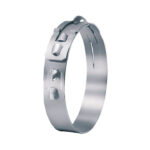
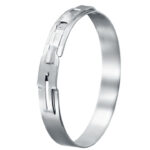
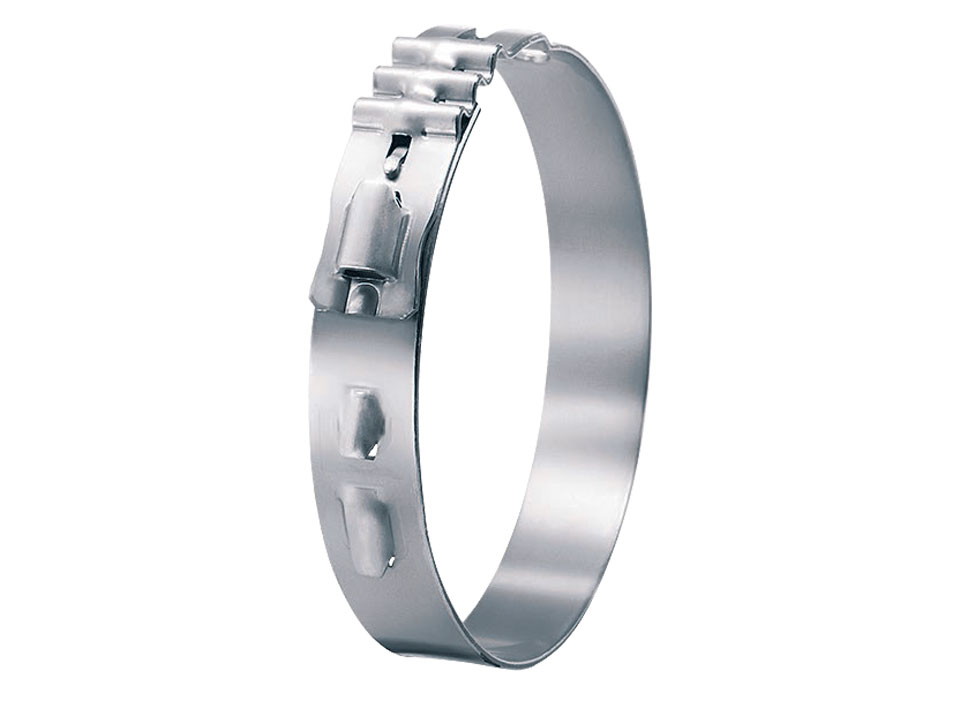

Tolerance Balancing Elements : Allows for changes in component tolerances and temperature differences
360 ° StepLess® : 360 ° uniform compression and constant surface pressure
Low Height After Installation : Minimum space requirement, low imbalance in rotating parts
New Tension Hook Design : Quick and easy assembly, high radial Force
Burr Free Slitting Edges : Less risk of damage to clamped parts
Material
192 Stainless Steel, Material no. 1.4301 / UNS S30400
StepLess® Low Profile Clamps Series 192 are manufactured with 1- fold and 3- fold tolerance compensation elements. The material sizes used in the standard series are determined by taking into account the radial force required, the application nature, and the requirements for sealing and / or holding under certain conditions and environmental exposure. During the selection of the clamp diameter, the
dimensions of the mating components on which the clamp will be mounted must be accurately determined in order to ensure an effective clamping performance . Durometer hardness of the soft material and the desired compression are important factors in calculating the appropriate clamp diameter.
Tension Hooks
Clamping hooks are special accessories used for tightening the StepLess® Low Profile Clamp Series 192. An Oetiker clamping tool locks into both clamps, and tool movement reduces the clamp diameter until the internal cavity of the clamping hook on the overlapping band is fully seated in the load holding hook.
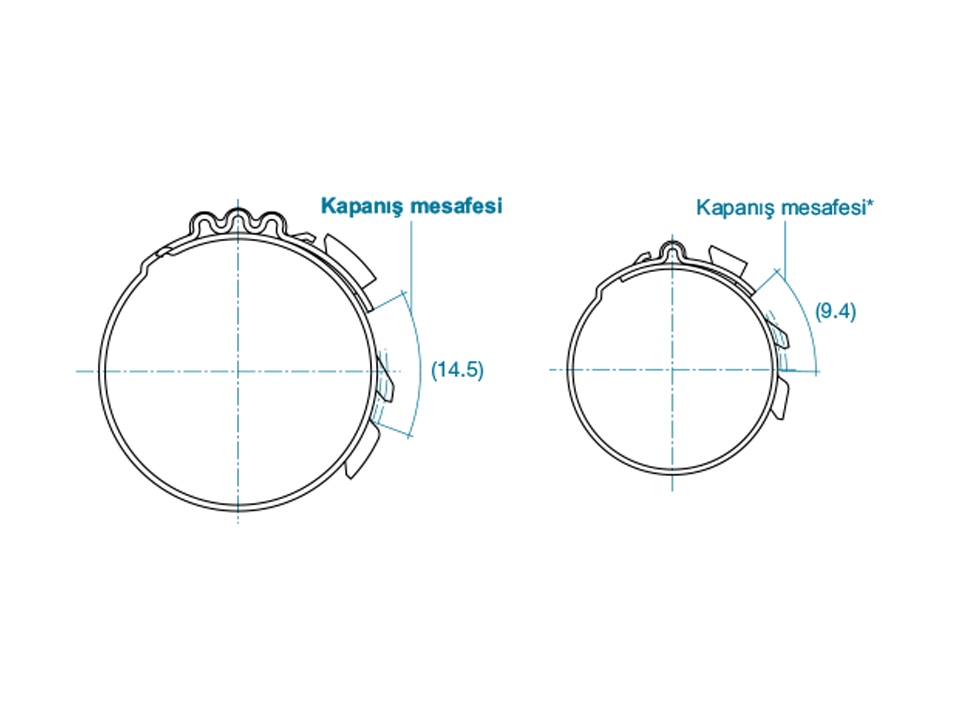
Tolerance Compensating
Tolerance compensating bends are activated when the application’s clamped diameter is greater than the nominal diameter of the clamp. When the resistance applied to the clamp exceeds the force of the bends created, elongation occurs to ensure successful locking of the tension and retention hooks. Flexibility of bends has the potential to adapt to diameter changes due to temperature changes or vibration effects. As a rule, the StepLess® Low Profile Clamp Series 192By selecting the nominal diameter of, the best hose or sealing compression should be achieved in the minimum installation diameter. At maximum assembly setup, the bends should be able to extend enough to absorb diameter while maintaining the ability to provide lock engagement, taking into account the maximum allowable pincer force and the amount of elongation the bends can withstand. Factors such as the capacity of the tolerance compensation element, the properties of the materials being joined, and the dimensional tolerance all directly affect the overall functionality of the connection.
Mounting Recommendations
These clamps can be mounted with manual pliers specially developed for this clamp structure, or alternatively with pneumatic pliers in high volume installations. To close a clamp, the pincer jaws must be locked into both tension hooks. Actuating the pneumatic tool or tightening the manual pincer, the simultaneous action of the two clamping hooks reduces the diameter of the StepLess® Low Profile Clamp 192 until an effective closed diameter is achieved.
The geometry of the StepLess® Low Profile Clamp 192 is such that when this position is reached, the inner contour of the tension hook at the overlapping end of the clamp automatically locks into the load holding hook. The resulting surface pressure depends on the selection criteria, especially the diameter and material of the clamped parts. The sealing performance is provided by the balancing force of the compressed elastic material combined with the tension caused by the tolerance balancing elements.