
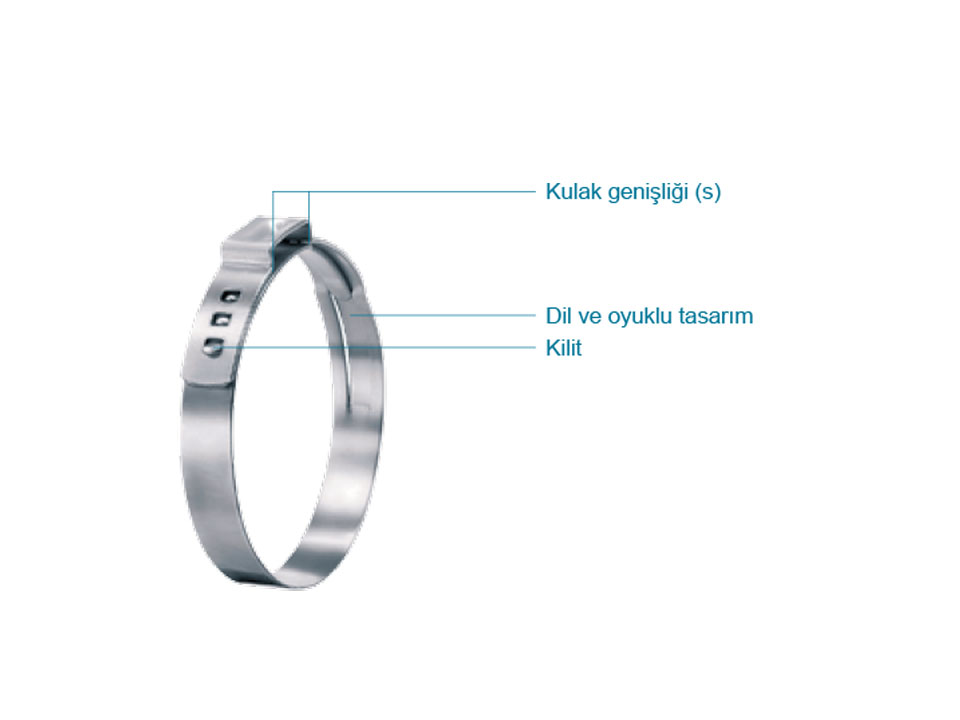
Narrow Band : concentrates clamping force transfer in one point, lighter
360 ° StepLess® : homogeneous compaction and homogeneous surface pressure
Clamp Lug : balances component tolerances, adjustable surface pressure
Pit : increases clamping force
Burr Free Slitting Edges : less risk of damage to clamped parts
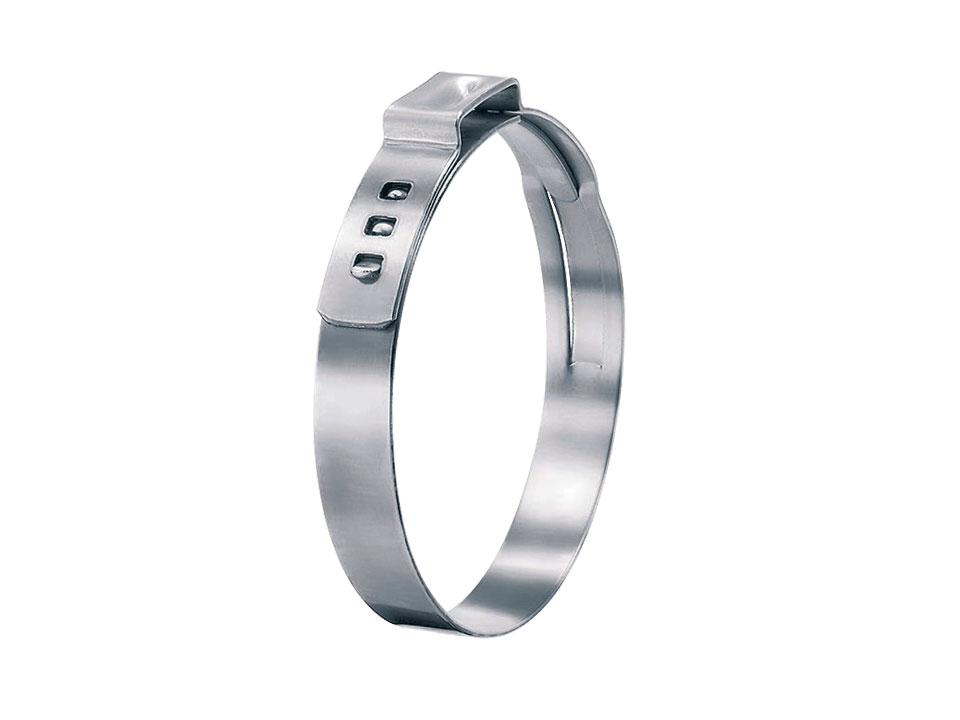
StepLess® (Stepless) Ear ClampsIt is produced in standard widths and thicknesses. The material sizes chosen for a particular application depend on the stress required to obtain adequate insulation or load. The clamp lug (clamping element) is tightened by bringing the lower oval corners of the clamp “ear” closer together, using tools designed or approved by Oetiker. The maximum diameter reduction is proportional to the open “ear” width (s). Outline: Push the hose onto the coupling material (eg nipple) to determine the correct clamp diameter then measure the outside diameter of the hose. Select a clamp whose diameter range average is slightly larger than the outer diameter of the hose. A clamp can be considered properly tightened only when the lug width (s) is reduced by at least 40% and the correct clamping force is applied for assembly.
Block tightening When the
mounting force completely tightens the ear, block tightening results in the two eartips touching each other (vertical members between the ear cup and the clamp radius). When this occurs, the assembly force is absorbed by tightening the legs rather than transferring the assembly forces to the clamped parts. Block tightening should be avoided if mounting forces are to be measured.
Mechanical Lock
Lock is a mechanical system that allows the clamp ends to be joined to allow tightening. Some lock structures can be opened to allow radial engagement prior to tightening.
Installation Recommendations The
clamp lug should be tightened with a uniform ratio not exceeding the maximum recommended tightening force. This ensures that the clamp tension remains constant without overloading the components of the assembled and clamps. Oetiker calls this mounting method “force priority”. The force priority method ensures that the tolerance compensation features of the clamp are functional for each assembly. This ensures that the radial force achieved remains nearly the same for each assembly, regardless of component dimensional differences. If using Oetiker’s ELK electronically controlled pneumatic pliers in the force priority mode, it is possible to monitor the assembly to ensure repeatable installations of appropriate force.
Clamping Force
In principle, the choice of clamping force is closely related to the desired compression or surface pressure of the material to be mounted. The resistance to which the clamp is subjected corresponds to the applied force, so the defined clamping force decreases significantly in soft materials. Maximum clamping forces are given in the table on the next page according to material sizes. These are especially thermoplastics or other less malleable materials with high Shore hardness.