
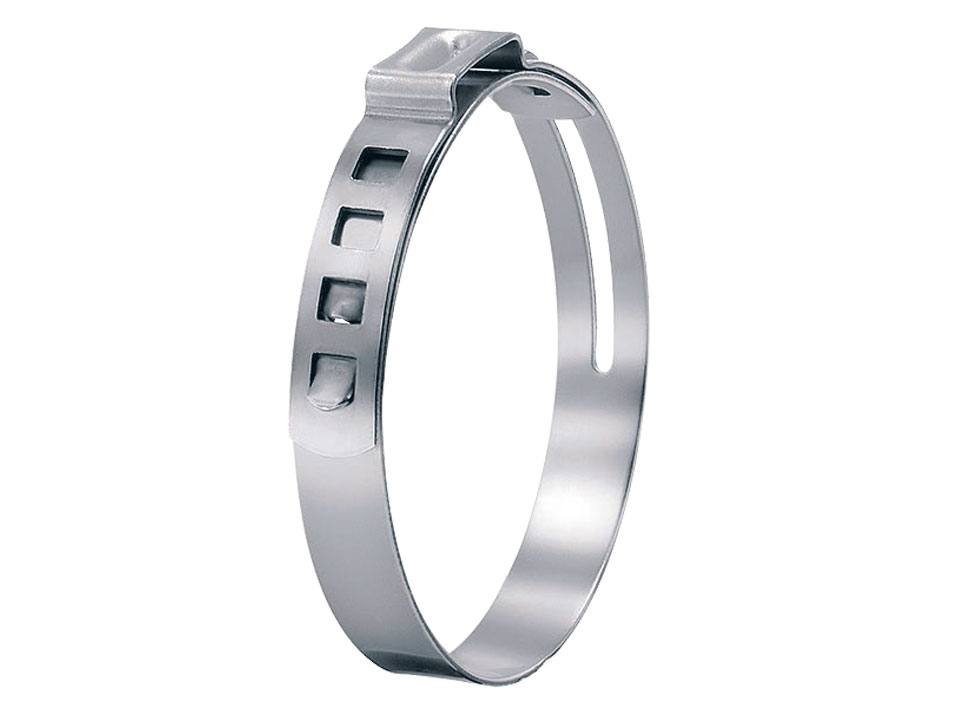
Locking position options: the clamp can be adjusted to various nominal diameters. Clamping
lug: easy and quick assembly, visible deformation indicates proper tightening
Burr-free slitting edges: less risk of damage to clamped parts
Connection technology: ideal for soft materials
Clamp lug (clamping element) The
clamp is tightened by bringing the lower oval corners of the “ear” closer together with the tools designed by Oetiker. The maximum diameter reduction is proportional to the open “ear” width (s).
Multi-position lock The
lock consists of one or two load-bearing hooks that can withstand the tensioning force during the tightening process and a lock tongue designed to hold these hooks in their windows before tightening. In both embodiments, the lock can be locked at different positions within the specified range. This feature allows a single part to be used for a range of diameters.
109 and 159 – Adjustable Clamps
109 Adjustable Clamps are supplied preformed and adjusted to the mean diameter. The 159 series clamps are supplied straight. The clamp needs to be formed before assembly. Each gradual movement of the lock reduces the diameter before tightening by about 1.6 mm. The assembly steps below show how an effective geometry can be best achieved. In both models, the clamp lug must be tightened with the force of the fixed tool jaw, this practice is called “force priority tightening”. This mounting method ensures a uniform and reproducible pressure on the application with a constant tension force on the mechanical lock.
Clamping force
Clamping force should be chosen to provide the desired material compression or surface pressure and defined by dimensional evaluation and trial. The resistance applied to the clamp is equal to the applied force, so the clamping force decreases significantly when clamping a soft material.